Here is the most expensive mistake companies make with AI: they treat it like a junior freelancer who just walked in the door.
You give it a vague task ("write a blog post about our new feature"), you get a vague result ("In today's fast-paced digital landscape..."), and you conclude that AI isn't ready for prime time. But the problem isn't the model. The problem is that you haven't given the model your operating system.
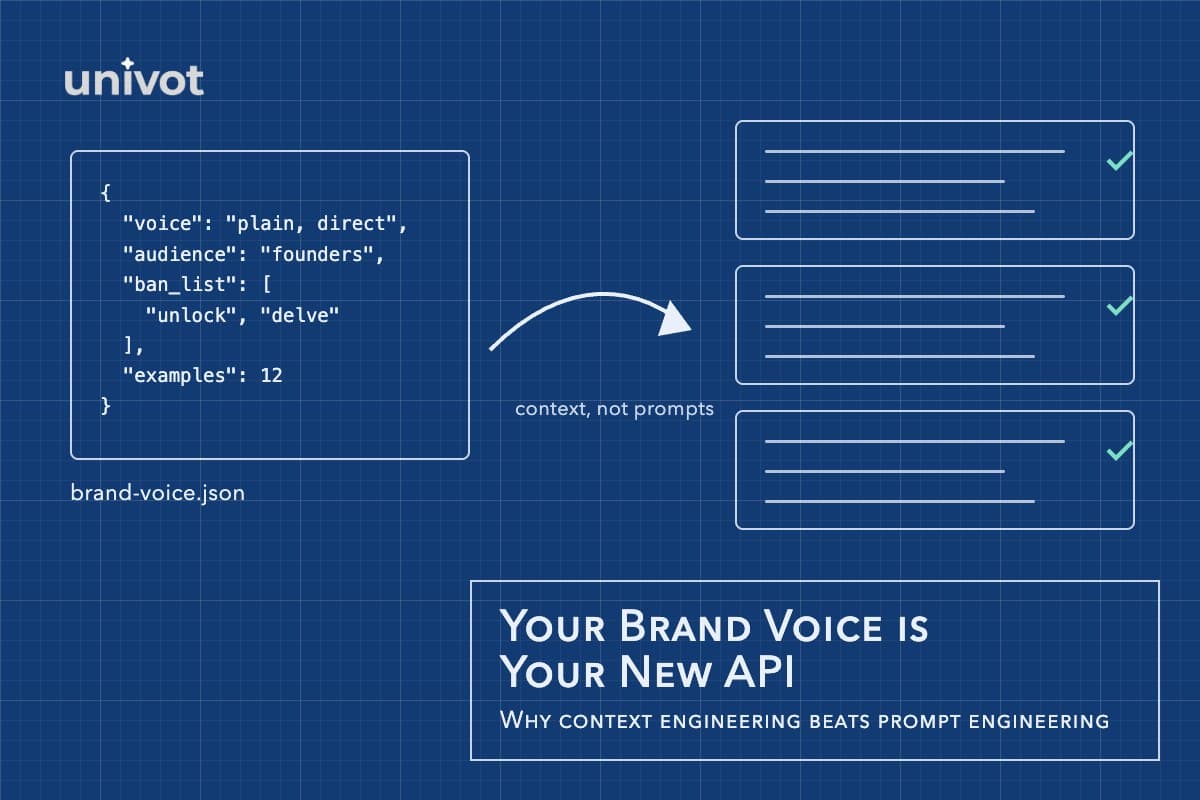
Your brand voice is no longer just a PDF guideline gathering dust in a Google Drive. It is now a functional API: a set of strict rules, data structures, and constraints that allows AI to interface with your business without hallucinating generic fluff.
The Shift: From Prompt Engineering to Context Engineering
We need to retire the term "Prompt Engineering." It implies that the magic is in the specific combination of words you type into a chat box. It suggests that if you just find the perfect "abracadabra," the AI will suddenly become a genius.
Real success comes from Context Engineering. This is the discipline of designing the entire information environment the AI operates in. It's not about the request; it's about the pre-loaded knowledge.
- •Prompt Engineering: "Write this email in a professional tone."
- •Context Engineering: "You are acting as a Principal PM. Use our 'Authority with Humility' voice. Never use the word 'delve'. Reference our Q3 roadmap for context. Now, draft a response to this client."
When you treat your brand voice as an API, you stop reinventing the wheel with every prompt. You load the "driver" once, and every application runs smoothly.
How to Build Your Brand Voice API
A PDF style guide is for humans. An API is for machines. To make your brand voice machine-readable, you need to break it down into explicit parameters.
1. Define the "System Instructions"
Your system instructions are the "kernel" of your brand API. They run in the background of every interaction. At Univot, our system prompt includes:
- •Role: "You are an expert consultant, not a hype-man."
- •Tone: "Direct, low-jargon, decision-oriented."
- •Format: "Use short paragraphs. Bullet points for lists. No walls of text."
In practice, this looks like a JSON object that you can paste into your AI tool's "System Instructions" or "Custom Instructions" field:
{
  "role": "Principal Product Manager",
  "voice_settings": {
    "tone": "Authoritative but humble",
    "style": "Direct, low-jargon, decision-oriented",
    "formatting": "Short paragraphs, frequent bullet points"
  },
  "constraints": {
    "no_fluff": true,
    "ban_list": ["delve", "tapestry", "unlock", "elevate"]
  }
}
2. The Negative Constraints (The "Ban List")
AI models love clichés. They are trained on the internet, which means they default to the average of the internet, which is mediocre. Your API must include a strict "Ban List" to filter out this noise.
The Univot Ban List:
- •"Delve" (The hallmark of ChatGPT)
- •"Tapestry"
- •"Unlock"
- •"Elevate"
- •"In today's world..."
- •"Game-changing"
- •"Revolutionary"
By explicitly banning these words, you force the AI to work harder. It has to find a specific, meaningful way to say "improve" instead of lazily saying "elevate."
3. Few-Shot Examples (The "Training Data")
An API needs test cases. In AI terms, these are "few-shot examples." You don't just tell the AI what to do; you show it what "good" looks like.
Provide 3-5 examples of your best writing. Show a "Before" (generic draft) and an "After" (on-brand rewrite). This allows the model to pattern-match your sentence structure, vocabulary, and rhythm.
Your domain expertise is the payload. The AI is just the carrier protocol.
Domain Expertise: The Missing Variable
Here is where non-technical founders and marketers have the advantage. You have Domain Expertise. You know your customer's pain points. You know the nuance of your market.
Most people use AI to replace their thinking. "Think for me, ChatGPT." That fails. The winners use AI to *translate* their thinking. "Here is my expert analysis of the market. Translate this into a compelling LinkedIn post using our Brand API."
Your expertise provides the *substance*. The Brand API provides the *style*. When you combine them, you get content that scales without losing its soul.
The "Context-First" Workflow
Stop starting with a blank chat window. Build a "Context Library": a folder of markdown files that contains your Brand API, your product specs, and your customer personas.
- 1.Load Context: Paste your Brand API and relevant background info.
- 2.Input Expertise: Dump your raw thoughts, meeting notes, or bullet points.
- 3.Generate: Ask the AI to synthesize your expertise through the lens of your Brand API.
- 4.Refine: Edit the output (and feed the edits back into the API to improve it).
The Tech Stack for Context
You don't need complex software to start. Here is the "MVP" stack for Context Engineering:
- •Claude Projects: Create a "Project" in Claude. Upload your Brand API markdown file and your product docs. Now every chat in that project automatically knows who you are.
- •ChatGPT Custom GPTs: Build a private GPT. Paste your system instructions in the "Configure" tab. Upload your style guide to the Knowledge base.
- •Cursor / Windsurf: For technical teams, add a `.cursorrules` or `.windsurfrules` file to your project root. This is literally a text file that tells the AI how to code for you.
Your file structure should look like this:
/context
  ├── brand-voice.md       # The "API" (Tone, Style, Ban List)
  ├── product-specs.md     # The "Knowledge" (Features, Pricing)
  └── customer-personas.md # The "Target" (Who we are talking to)
This is how one person does the work of ten. Not by typing faster, but by engineering a system where the AI knows exactly who you are before you even say hello.
Turn Your Brand into Code
At Univot, we don't just build websites; we build Context Engines. We help companies codify their brand voice, operational knowledge, and strategic IP into a system that AI can actually use.
When you do this, the dynamic changes. You stop fighting the AI to make it sound less robotic, and you start directing it to solve real business problems. You move from being a "prompt engineer" (guessing words) to a "context architect" (designing systems).
If you're tired of rewriting every single piece of AI-generated content, it's time to stop prompting and start engineering.